
Digital
Trust Infrastructure
Built for Bharat
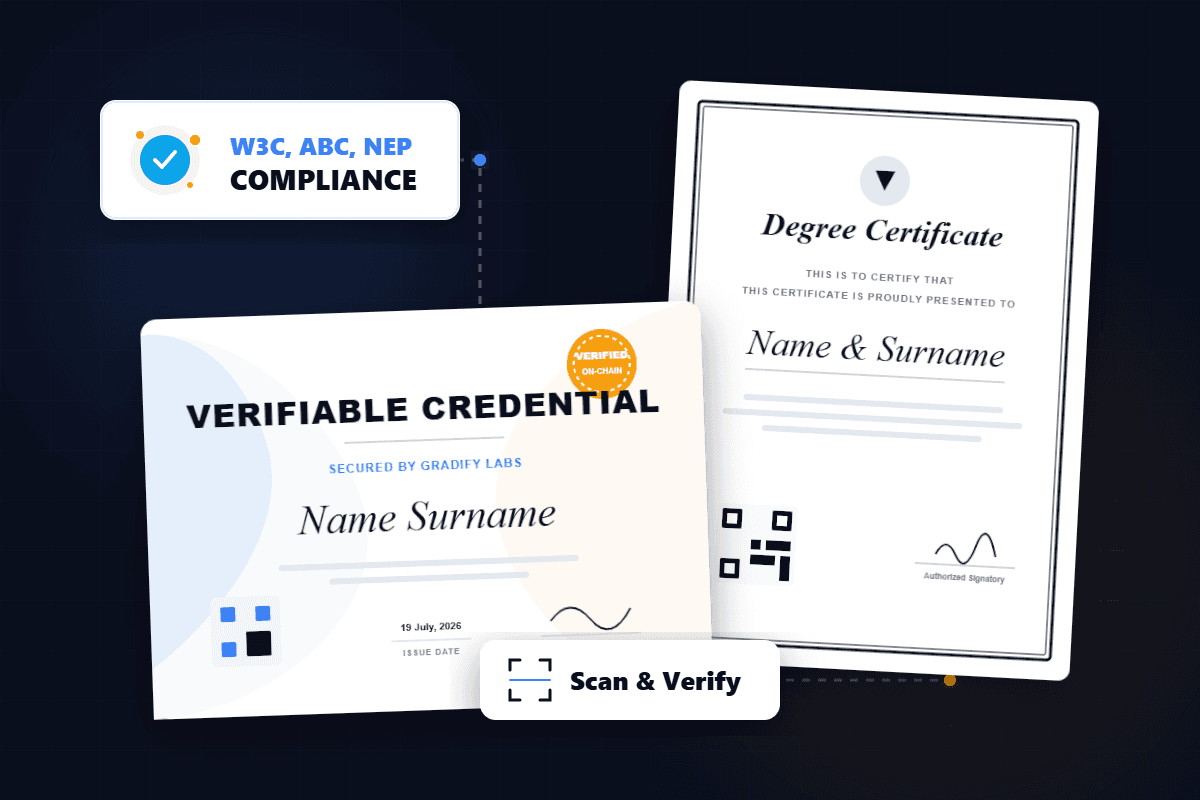
Issue tamper-proof documents, certificates, and badges on a permissionless blockchain. Instant verification for employers, institutions, and government systems.
Live traction · updated as we issue
Live at institutions across India
Issuing and verifying credentials on-chain for universities, colleges, and professional bodies.


Paper documents were built for a world
that no longer exists
Every organisation issues millions of official documents - degrees, invoices, purchase orders, NOCs, government orders, letters, and ID cards, almost none of them independently verifiable in real time. The result is a multi-billion-rupee trust gap that costs issuers, recipients, and everyone whose name is on the document.
The way it works today
Forgery is effortless
A convincing fake a degree, an invoice, a No-Objection Certificate, an ID card, takes minutes in a PDF editor. A paper or PDF document has no way to prove it is genuine.
Verification is slow and manual
Recipients email the issuer and wait days or weeks for a reply. Most never verify at all forged degrees, fake invoices, and altered orders slip straight through.
Issuers carry the cost
Every forged document in your name academic, financial, or legal, erodes the value of every real one, and today you have no way to prove which is which.
Records are siloed and fragile
Paper and PDFs get lost, altered, or trapped in systems that don't talk to each other. Across departments and document types, there is no single source of truth.
The Gradify way
Tamper-proof by cryptography
Every credential is signed and anchored on-chain. Alter a single character and verification fails, forgery becomes mathematically impossible.
Verified in under 3 seconds
Anyone can confirm a credential instantly through a free public verifier no login, no email, no call to your registrar's office.
Your reputation, protected
A single cryptographic source of truth means a fake in your name can never pass. Every document you issue stays credible for life.
One permanent, portable record
Anchored on a permissionless blockchain and IPFS, no vendor lock-in, no single point of failure, verifiable anywhere, forever.
We turn every document your organisation issues into a credential the world can trust in seconds and that no one can fake.
See a live verificationOne platform for every document
your organisation issues
We started with academic credentials but the same tamper-proof rail issues and verifies anything an institution, business, or government office produces. If it has a signature today, it can be a verifiable credential tomorrow.
Academic Credentials
Degrees, diplomas, transcripts, marksheets, and micro-credentials.
Invoices & Receipts
Tax invoices and payment receipts that buyers can verify instantly.
Purchase Orders
Procurement orders with tamper-proof line items and approvals.
No-Objection Certificates
NOCs issued and revoked on-chain, no forged clearances.
Government Orders
Notifications, gazette orders, and sanction letters, publicly verifiable.
Official Letters
Appointment, experience, and authorisation letters that can't be faked.
ID Cards & Passes
Employee, student, and member IDs verifiable with a single scan.
Any Custom Document
Bring your own template, issue it as a verifiable credential via API.
From paper to provable
in four steps
Blockchain makes a document tamper-proof. AI is what sets us apart - it reads, screens, and watches over every document at each step, so you get more than a digital certificate. You get an intelligent one.
Issue any document, at scale
Create degrees, invoices, purchase orders, NOCs, ID cards, or any custom document from your own templates, one at a time or thousands in a single batch.
- API-based issuance & CSV bulk upload
- Blockchain-backed eSign & digital sign
- Plugs into your existing ERP / SIS
AI reads your legacy PDFs and scanned paper records, auto-extracts every field, and maps them to the right template - no manual data entry.
Anchor it on the blockchain
Each document is cryptographically signed and anchored on a permissionless blockchain, with metadata pinned to IPFS. Alter a single character and verification fails forever.
- Tamper-proof & mathematically guaranteed
- Decentralised IPFS storage, no lock-in
- Instant revocation when you need it
Before anything is minted, AI screens for duplicates, mismatched records, and anomalies, so a bad document never gets anchored in the first place.
0x8f3a…verified · IPFS pinnedAnyone verifies in under 3 seconds
Recipients scan a QR code or paste an ID into the free public verifier. No login, no fee, no phone call to your office - a tamper-evident result in seconds.
- Free, unlimited public verification
- QR scan or credential-ID lookup
- Works for employers, banks & governments
Someone uploads an off-chain copy? AI forgery detection spots edited fonts, doctored fields, and tampered scans in real time, catching fakes the chain alone can't see.
Track, report & stay compliant
See every view, verification, and download in real time. Issuance analytics map straight to NAAC, NAD, ABC, and DigiLocker, so compliance reporting writes itself.
- Live analytics for views & verifications
- NEP 2020 · NAD · ABC · DigiLocker sync
- Exportable, audit-ready evidence
Ask in plain English: "which documents were verified abroad last week?" AI answers instantly and flags suspicious verification patterns before they become a problem.
Deployed · Backed · Recognised
Trusted infrastructure
Gradify is live at an Institute's, grant-backed by the Solana Foundation, and recognised under Startup India, built on the cloud and accelerator programmes that scale serious infrastructure.

Coinbase
Solana Foundation

AWS Activate
Microsoft for Startups

SSIP Gujarat
DPIIT

Startup India
Udyam MSME
CDAC
Startup Rajasthan

Vibrant Gujarat Regional Conferences
National Skill Development Corporation
Advisory Board
3 advisors across academia,
research & quality assurance



Everything your institution needs
to go fully digital
From first credential to NAAC audit one platform, one integration, every standard covered.
Tamper-Evident Architecture
Credentials anchored on a permissionless blockchain are immutable and cryptographically verifiable by any party, anywhere no intermediary required.
Cryptographic ProofNear-Instant Verification
AI-accelerated parsing validates issuer signatures and returns a tamper-evident result in under 3 seconds. No registrar wait. No manual review. Free for everyone.
Under 3 SecondsBulk Credential Issuance
Issue thousands of degrees, diplomas, and micro-credentials in a single batch operation, directly from your existing student records system via API or CSV upload.
Convocation-ScaleDecentralised Storage
Credential metadata stored on IPFS, a permissionless, content-addressed network ensuring permanent, censorship-resistant preservation for the lifetime of the credential.
IPFS BackedAI Fraud Detection
Machine learning models continuously analyse verification patterns and access signals, flagging fabricated credentials and anomalous activity in real time before they reach hiring pipelines.
Real-time AINAAC-Ready Reporting
Issuance and verification analytics map directly to NAAC IIQA and AQAR formats: criteria 1.4, 2.6, 4.4, 5.3, 6.2, and 7.1 covered with exportable evidence dashboards.
Accreditation ReadyEvery standard Indian universities
are mandated to adopt
Eight pillars one integration. Gradify handles all of them out of the box, so your registrar and IQAC teams don't have to.
Questions registrars and CTOs ask us
Short answers to the questions we get most often during institutional evaluations. For implementation specifics, see the dedicated guides linked from each answer.
How is a blockchain-based degree verified?+
Does Gradify support W3C VCs, DID, and OpenBadges 3.0?+
How does this fit with NEP 2020, ABC, NAD, and DigiLocker?+
Is verification really free for everyone?+
Can credentials be forged or altered after issuance?+
What does NAAC peer-review evidence look like?+
Ready to bring verifiable credentials
to your institution?
We welcome conversations with universities, government bodies, and digital infrastructure teams exploring permissionless credential infrastructure.